fortrabbit agent skills — early preview
Published
🦾
Deploy with agency.
We just published a first preview of fortrabbit agent skills — a set of plain-text instruction files that teach AI coding assistants like Claude how to deploy code to fortrabbit, sync databases, and work through common platform tasks. It's an early release. How we got there.
What are agent skills anyway?
It's a new shiny thing. AI coding assistants, like Claude and OpenAI Codex, know a lot about development already. But they can also be extended with domain-specific knowledge. A skill is a Markdown file that tells the agent how to operate in a given context. Think of it as documentation written for a machine rather than a human, but readable enough that a human can follow along.
Often, you'll create your own agent skills so the tool knows your best practices. But ready-made skills also exist, for example:
The new fortrabbit agentic skills
See the fortrabbit skills repository on GitHub and the agent skills docs for the full command reference and configuration options. Try them out right away:
curl -fsSL https://raw.githubusercontent.com/fortrabbit/agent-skills/main/install.sh | sh
This will install the skills in your local user agent config folder. They can also be installed on a per-project basis and also using the GitHub command line client gh. See the repo for more install options.
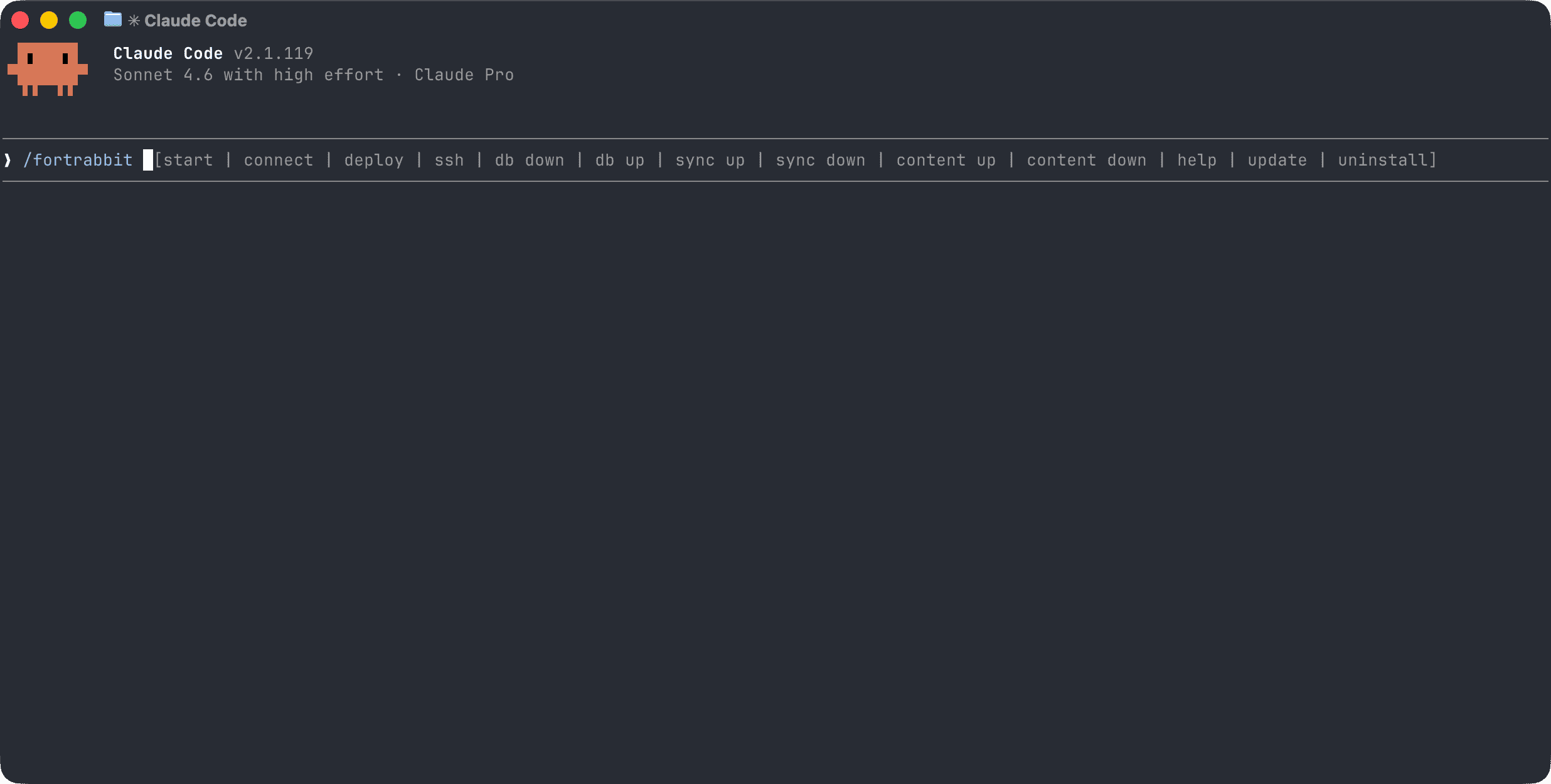
Then, open your agent and type /fortrabbit and follow along. They can also be invoked by natural language, like when mentioning deploy this to fortrabbit.
What it does
The current skills cover core operations:
- Deploy code via Git or rsync
- Sync databases up and down
- Handle content syncs for CMS setups
- Work through common Craft CMS workflows — similar to what Craft Copy handles today, but not tied to Craft CMS
fortrabbit supports several deployment modes: pure Git, rsync, or a hybrid where code ships via Git and user-generated content syncs via rsync. The instructions cover these different setups rather than assuming a single workflow.
The skills are also reasonably failure-tolerant. If a step fails, the agent can identify what went wrong and often suggest an alternative route.
What thrills me
Already useful today. I hope this will become popular for users during onboarding and initial setup. Getting a fresh local project connected to fortrabbit — credentials, SSH keys, deployment method, environment variables — is where many new users drop off. This can cut through the chicken-and-egg problem: test the platform without already having a project ready, but without compromising too much. We never liked the idea of one-click installers, where you end up with generic code on the server but nothing running locally.
An agent that knows fortrabbit can walk you through setup interactively. Set up a project in your local development environment, run a deployment, see it work on the remote.
What worries me
Dangerous operations. Some tasks an agent can trigger — overwriting a database, deleting files — are destructive and hard to reverse. The skill instructions are written to be careful, but agents can and do misread context.
Hallucinations. While testing, Claude couldn't always work around unexpected problems — sometimes it created new ones. A skill file narrows the surface area for errors, but multiple times it confused old platform with the new platform config.
Maintenance burden. The skill files are effectively a second version of our user documentation in a different format. Keeping them accurate as the platform evolves is real work, even when we generate them.
So many standards. The agent skills space is moving faster than JavaScript frameworks. As far as I know, at the time of this writing, there's no npm or Packagist equivalent for skills — no common registry, no agreed versioning. GitHub is adding skills management to their CLI. Cloudflare is proposing a .well-known discovery standard. There might be different marketplaces. These may converge or they may not. We're shipping against that uncertainty.
Implicit prose in Markdown. Instructions are human-readable, the agent interprets them with some latitude. Part of me wants them to be far more explicit and structured. I'm still working out where that balance should be. The agentskills.io website suggests not cross-referencing, and repeating important information instead, to save on token usage. My instinct is more DRY.
A bigger threat
A double-edged sword. The technology is impressive. But it is also an immense stress test for our business. At fortrabbit we aim to make hosting fun for humans. I am proud of what we have built. Yet some of the paradigms agents may make us less relevant: headless hosting, infrastructure as code, AI-generated configuration. Setting up a docker-compose.yml is no longer a dark art. Part of what we solve is simply not that hard anymore.
What's next
The skills will become much more useful once we have a proper API and CLI on the fortrabbit side for the new platform. We will get there. Right now, most of what the agent does goes through SSH and Git — functional, but limited in scope and a bit fiddly.
We're also considering splitting the current skill into smaller, more focused skills for different use cases. And we're tracking the discoverability standards to make sure the skills can actually be found by agents that need them — once that landscape settles.
For OpenAI Codex, dedicated testing is in the works.
Try it and tell us
Install the skills, try deploying a project with your AI assistant, and let us know what happens. What worked, what confused the agent, what's missing — all of it is useful. It will directly shape where this goes next.
Side notes
Agent skills are a relatively new feature. It will evolve. It's crazy, how all players want to be in the pole position.
- Microsoft integrated SKILLs discovery with gh client
- Cloudflare pushes automatic discovery via .wellknown
- Anthropic is a bit sleepy about their market place
- Custom market places pop up: agentskills.host, getagentskills.com, skillpub.net